
As You Like It, by William Shakespeare
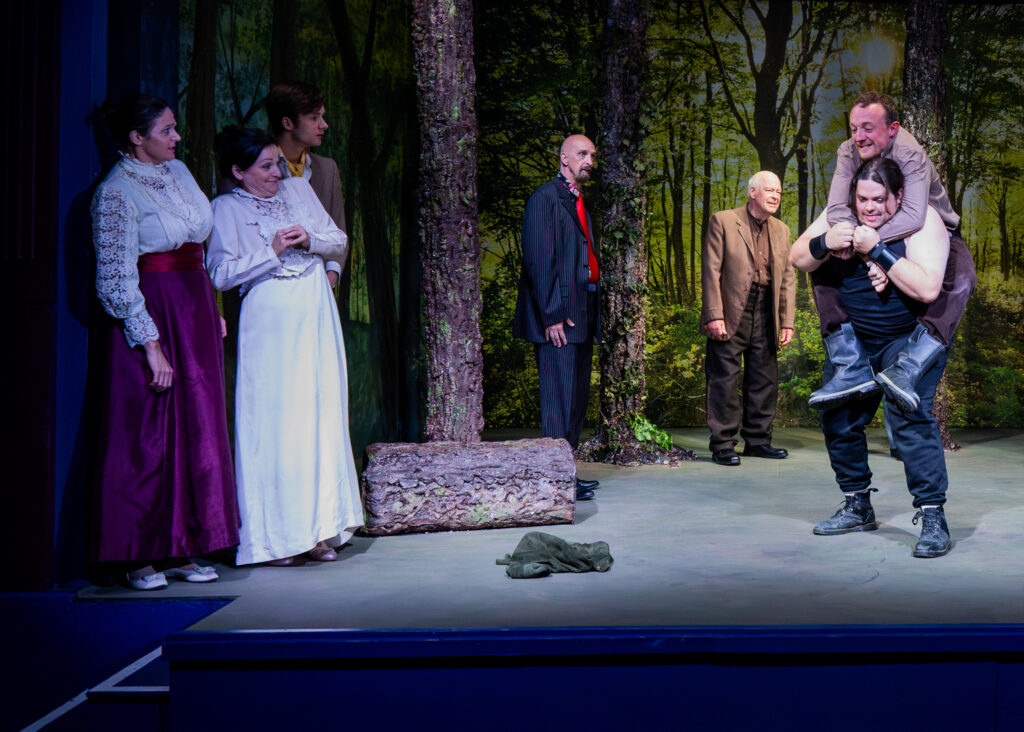
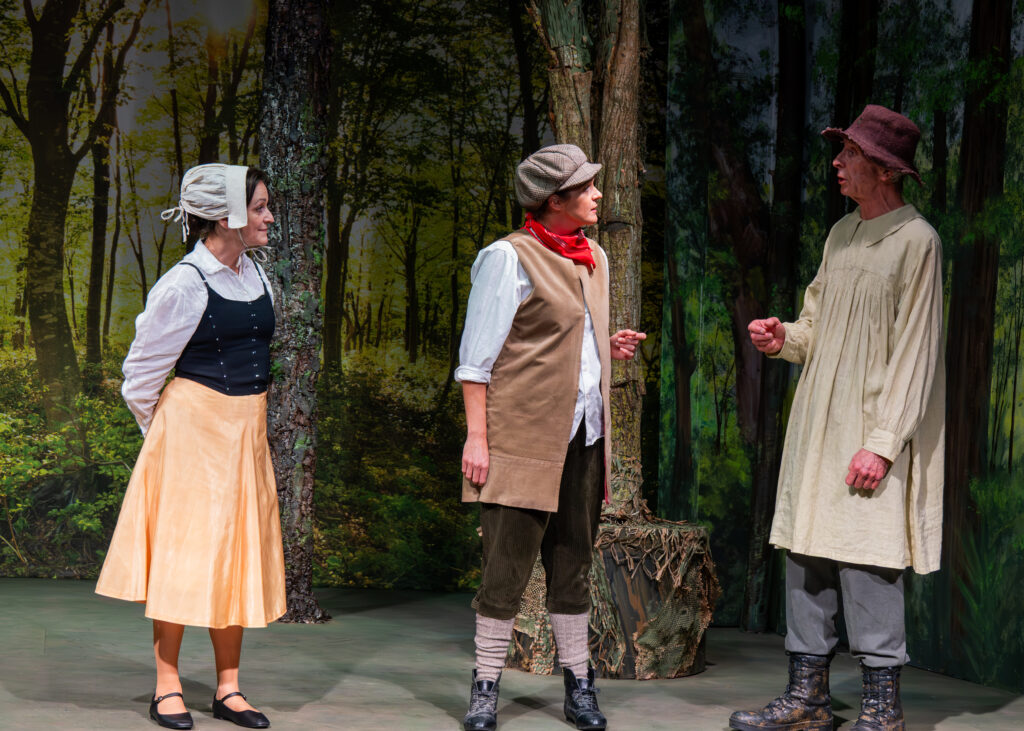
Coping with a heatwave and Shakespeare is a bit of a double whammy for some of us, but hats off to Harborough Theatre for pulling out all the stops to convey the story of the Bard’s popular As You Like It. Director Jan Wilson drilled this huge and capable cast of 15 so that you could almost feel their determination to draw their audience in.
It’s described as one of Shakespeare’s ‘more accessible’ comedies. Well, I’m not sure about that. Space restriction prevents a full explanation, but it’s basically about people falling in love, others hating each other, girl pretends to be boy, etc. Suffice to say they end up having a mass woodland wedding and everybody’s happy.
Again sadly, space prevents naming the complete, talented cast, but Alison Kennerdell and Kyle Newman were outstanding as cousins and besties Rosalind and Celia. Natural and amusing with great audience communication. Dan Creedon as Orlando, with the hots for Rosalind, is the hero of the piece and his placid, gentle nature was beautifully played and paced. Michael Dray’s characterisations of warring brothers Duke Frederick (the bad) and Senior (the good) was splendid.
The mix of modern and traditional costumes worked well – each outfit expressing the character. My favourite was the colourful jester, Touchstone, energetically played by Steve Wilson.
The whole piece was set in the Forest of Arden – represented by a beautiful set.
I admit to not being a Shakespeare fan and I did ‘lose the plot’ at times, but this was an interesting end to the theatre’s current season.
Edited from Gordon Birch’s item in the Harborough Mail. (Photography by Andrew Wallace)
Breathing Corpses, by Laura Wade
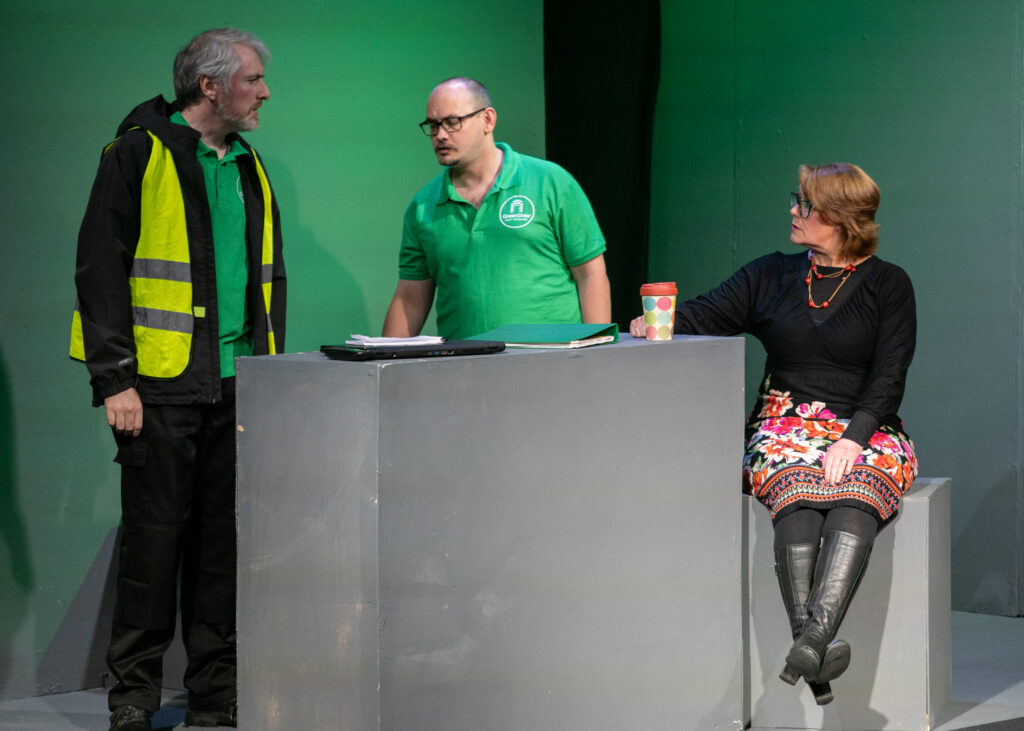
It only lasted 90 minutes, but I was wrung out by the end of Harborough Theatre’s latest production. The tight and smart cast of seven led us through Breathing Corpses, cleverly drawing the audience into Laura Wade’s stress-loaded script, which starts at the end and progresses through the scenes that led to it.
In short, Jim, a storage firm manager, notices a bad smell coming from a box. The gruesome contents turn his mind and he ends up dying by suicide in a hotel.
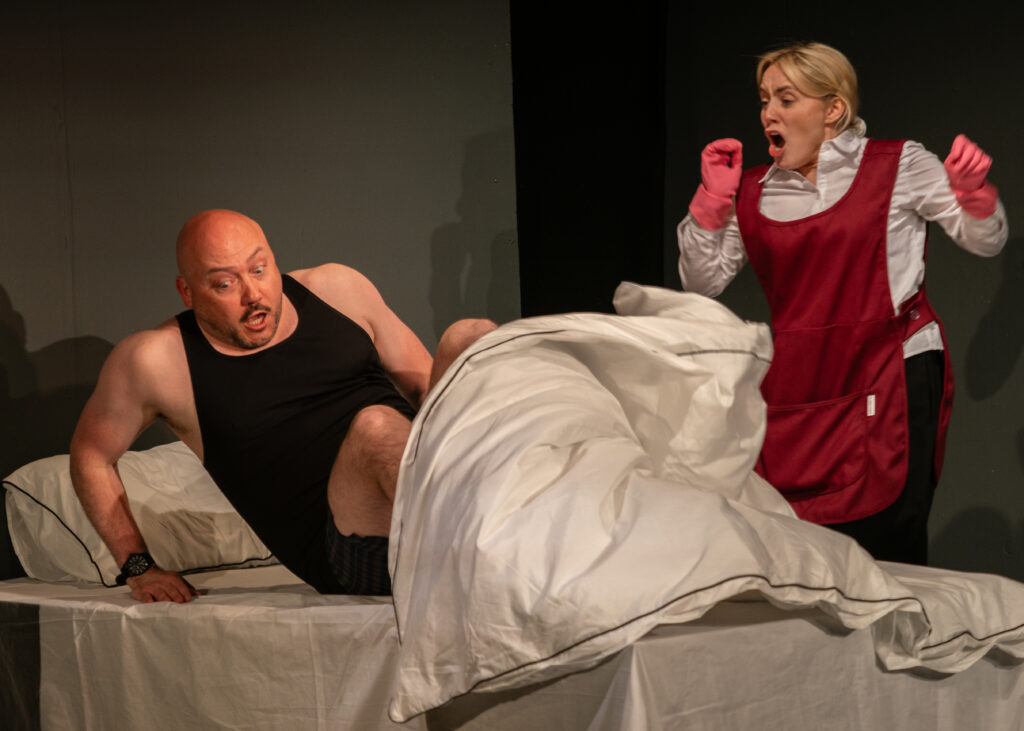
Yasmin Luxford played maid Amy, who finds him. Her impressive interpretation was equally balanced with naivety and humour.
Tony Ruscoe championed the challenge as Jim, successfully delivering his descent into depression. Pam Cousins showed empathy with attention to every mannerism and word, as his gossipy wife, Elaine. Ben Lewis brought a lighter touch as Jim’s colleague, Ray.
The body in the box was Kate, played by Verity Davis – stressed by work, a heatwave, her partner’s dog and the discovery of a girl’s body in the park. Tension in scenes with partner Ben, was palpable. Connor Scott developed Ben’s character from calm until he finally ‘lost it’ and Kate ended up as the bad smell in the box.
The identity of the body in the park was unexplained, but I believe it was Amy, who falls for the charms of Charlie, a smooth-talking knife-salesman and hotel guest. Laurence Jackson was suitably creepy as he talked the ill-fated Amy into a date.
Congratulations to directors Paul Barrass and Alison Dawson on a professional and intriguing show.
From a review by Gordon Birch in the Harborough Mail. (Photography by Peter Crowe.)
Jerusalem, by Jez Butterworth
A play with a warning of adult themes, very strong language and an estimated 11pm finish didn’t sound like a lot of fun. How wrong could I be? Maybe ‘fun’ is overstating it, but Harborough Theatre’s latest offering, Jerusalem, was a revelation.
Harborough audiences are used to director Neil Lovegrove’s challenging play choices, and this, by Jez Butterworth, was one.
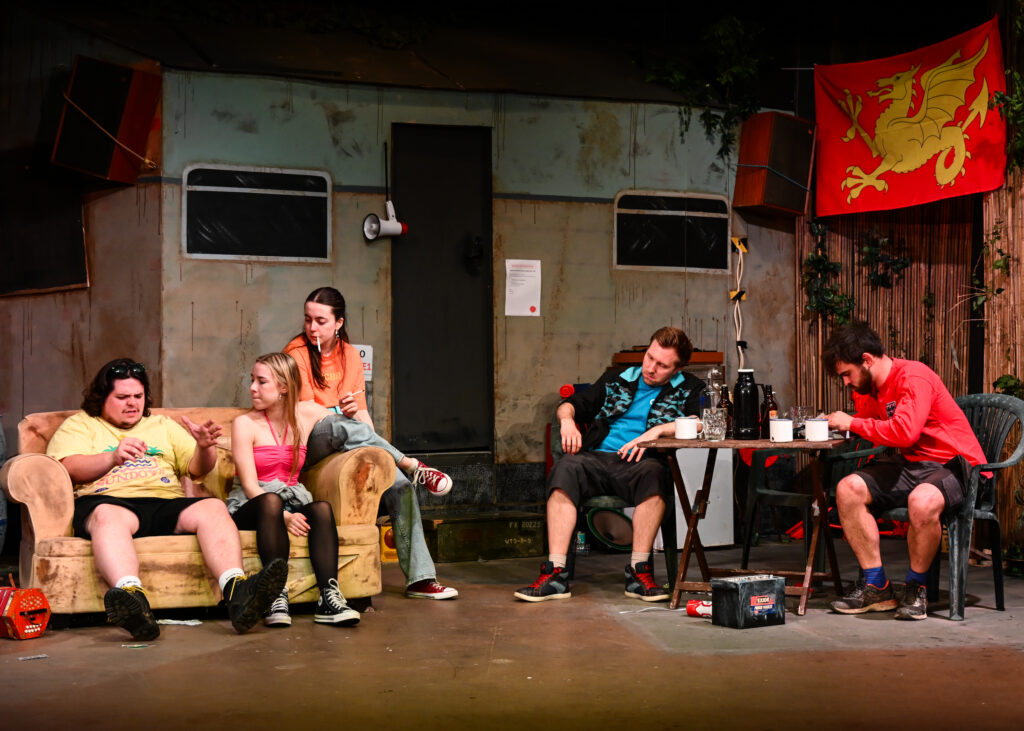
Central character is antihero caravan dweller Johnny ‘Rooster’ Byron, whose illegal woodland campsite provides youngsters space for drugs, alcohol and dubious goings-on in general. But a housing estate is planned and he faces eviction.
Mark Bodicoat is a veritable tour de force and perfectly cast as the magnetic Byron – revolting yet lovable, a liar yet credible. His foul-mouthed acolytes are recovering after a St George’s Day party fuelled by a variety of substances, courtesy of their host. They’re preparing to protest against council plans.
Characterisations among the 14 cast members were impressive. Of particular note was Luke Clarke as Ginger, who dares to question Byron’s stories, Dan Hands as Lee, about to emigrate to Australia, and Dan Masters as Davey. Tim Hands gave light relief as a bonkers professor and Caitlin Mottram fizzed as Dawn, Byron’s ex-partner. Jez Morris was truly menacing as Troy, suspecting Byron of hiding his daughter. Although after an apparently serious off-stage attack, Byron re-appeared looking rather too fit.
The set looked convincingly sordid and filthy – you could almost smell it.
This excellent cast also included Emma Beckett, Abigail Sterland, Isla Rogers, Tom Mackenzie, Kay Carpenter, Kevin Norris and Stanley Kennerdell.
Review by Gordon Birch for the Harborough Mail. (Photography by Andy Wallace.)

Quartet, by Ronald Harwood
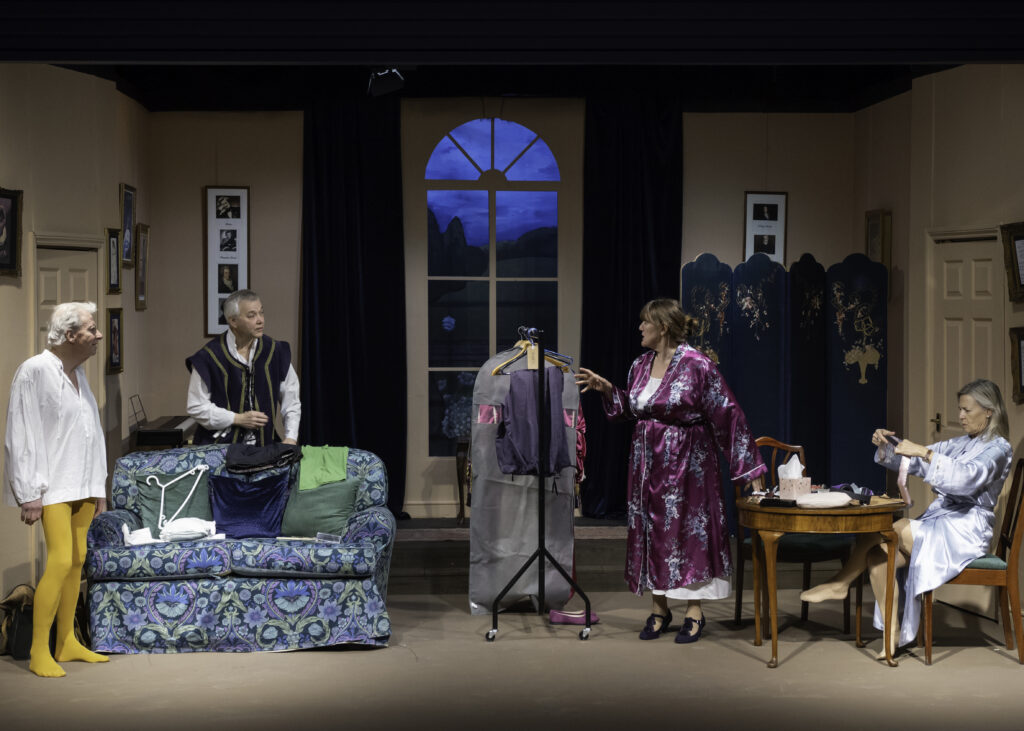
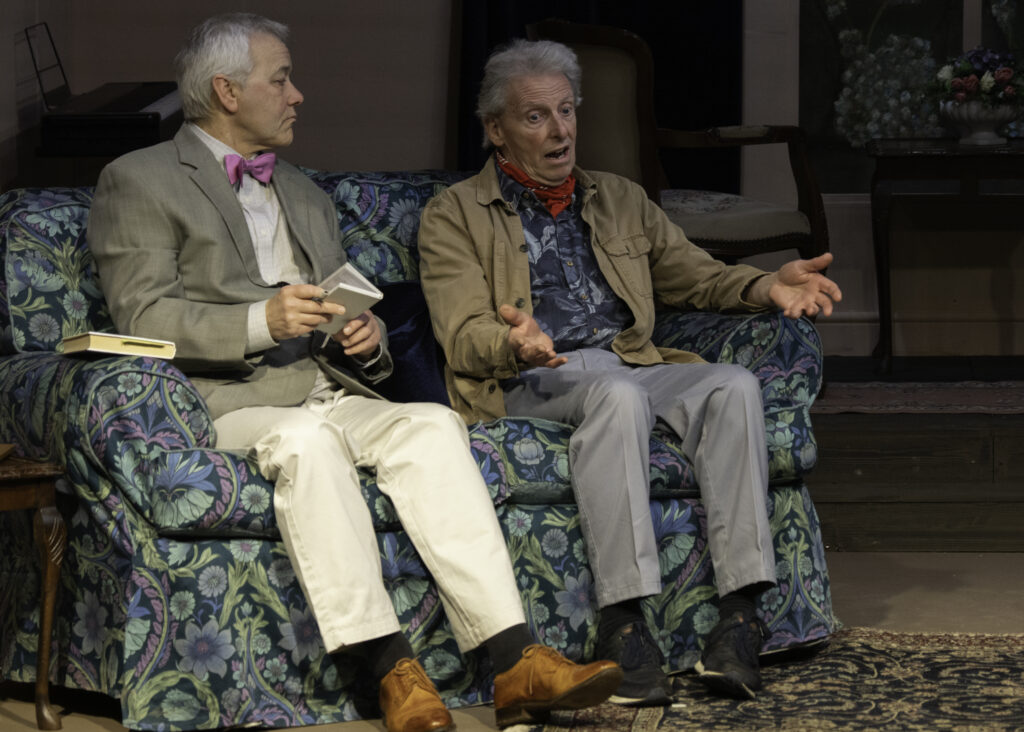
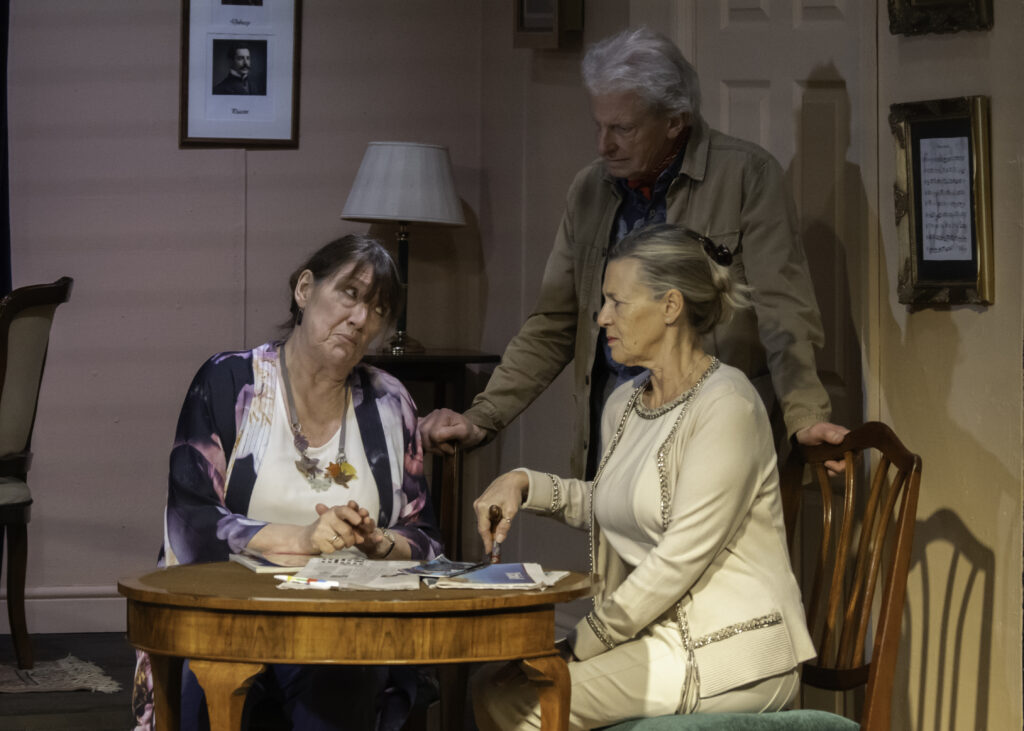
Set in a retirement home and revolving around the titular foursome of past-it opera singers, Quartet is a funny – at times very funny – meditation on the inevitable ageing process. How fitting, then, that Market Harborough Drama Society stalwart John Foreman should have been coaxed out of directorial retirement to call the shots on this one.
Mark Aspland is Reginald, whose “marmalade tirades” prove a highlight, offering an insight into what is clearly a deeply unsettled man put under further pressure by the arrival of his ex, the imperious Jean, played by Teresa Quigley. “It’s not fun,” Jean wails at one point, neatly encapsulating the show’s main theme. “Nothing is fun anymore.”
Cissy, meanwhile, is a delightfully optimistic Pollyanna, brought to life by the note-perfect Nicci Harvey, while few would argue that the show’s most valuable player is Tony Price as the terminally priapic Wilf. He has most of the rib-tickling lines (though Jean’s acidic put-downs of Cissy run him close), and he brings a mischievous 1970s sitcom energy to proceedings. Bravo.
Ultimately, as character layers peel away, the quartet reveal more of themselves and – especially in the second half – laughs are tempered by moments of melancholy and revelation. The result is a finely observed character piece as funny as it is moving and thought-provoking.
Edited from Andrew Holmes’ review in the Harborough Mail. (Photography by Peter Crowe.)
Foxfinder, Studio Production
Comments from the audience.
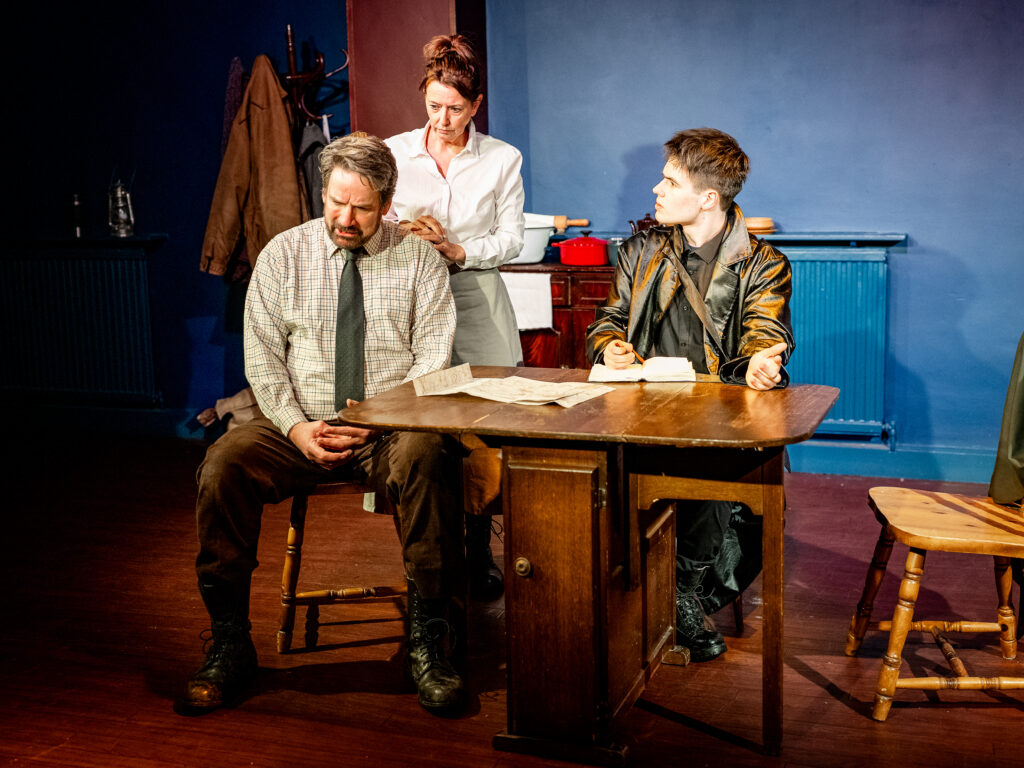
The performances were excellent including the scene changes. It’s great see younger generations involved and doing so well! Very atmospheric and kept me transfixed.
Good story, well acted.
The acting from all actors was outstanding, the director did an amazingly good job!
Engaging, exciting and great fun
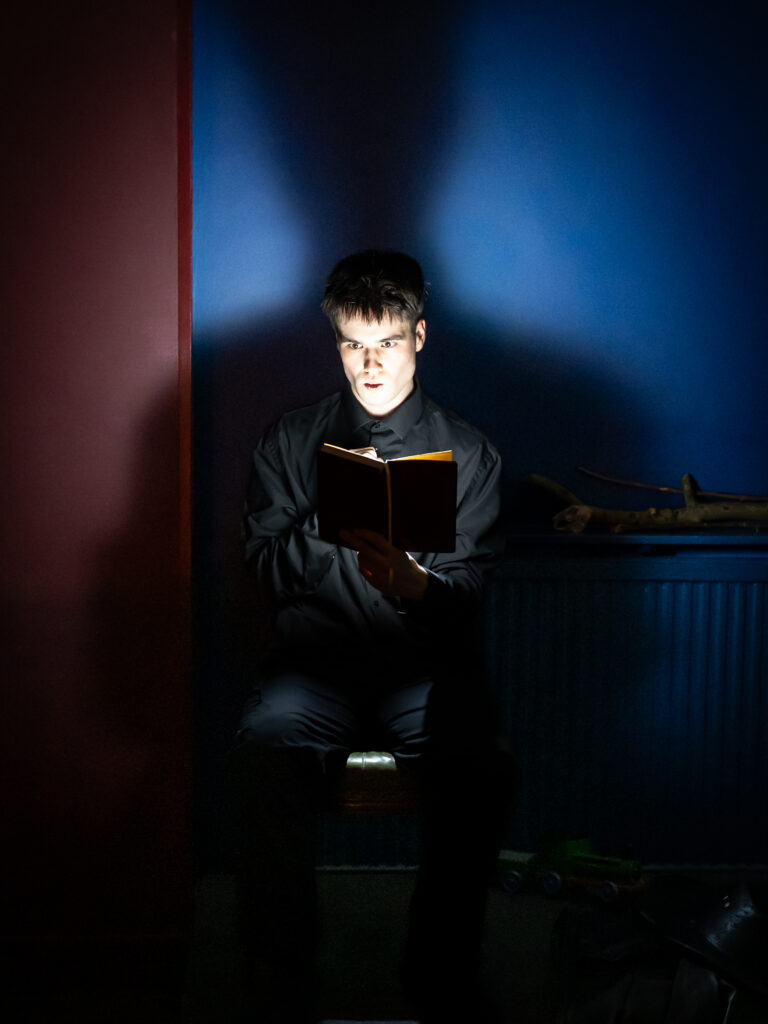
It was great! Dark, brooding atmosphere of fear. Very well acted
The overall production of this play was very high, from the lighting and music to the intense direction and performance of the actors. It is not normally the type of play I go to see but the quality of production shone through. From the opening scene with no initial dialogue the actors held the audiences attention throughout. I look forward to the next studio play.
This was a difficult subject handled extremely well in an intimate space by a cast of realistic believable actors. The level of tension was maintained throughout. (Directed by Steve Wilson, photography by John Harrison)
Bleak Expectations
I was concerned that my scant knowledge of Dickens’ novels might be inadequate to really enjoy Harborough Theatre’s latest production, Bleak Expectations. I needn’t have worried as this comedic romp bore only a passing resemblance to anything CD ever wrote.
Many theatres stage a panto in January and this hilarious show was on the brink.
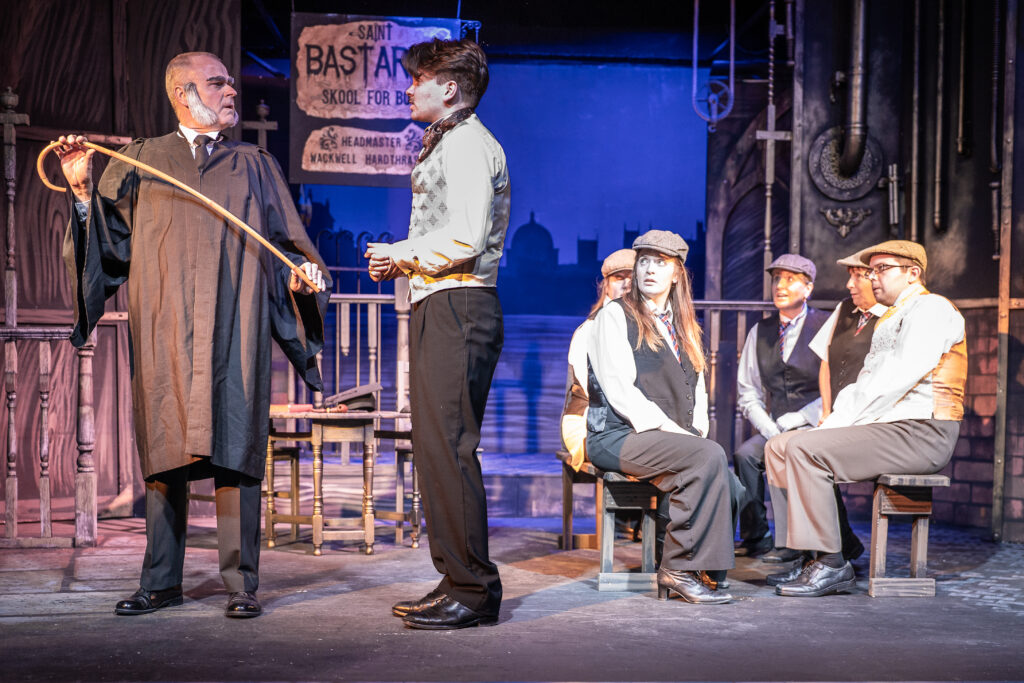
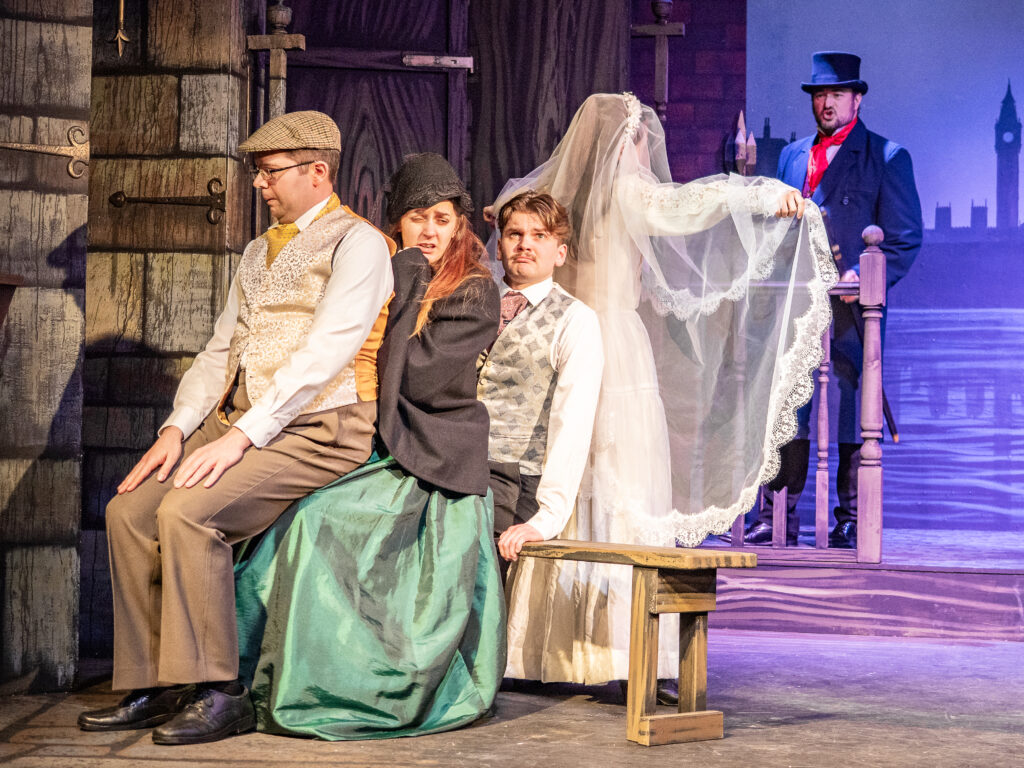
Directed by Mark Bodicoat, the tight-knit cast of 12 took us through Mark Evans’ wacky script, parodying Bleak House and Great Expectations with references to many other Dickens works thrown in.
Gloriously bonkers, it included headteacher Wackwell and his cane called Michael (see what I mean?), a pupil (think Oliver) who pleaded for less food as it was so disgusting and a mad woman who thought she was a cat.
We were guided through the totally bananas plot by chocolatey-voiced Charles Hilsdon as Sir Philip Bin reflecting on his life.
As a company, this was truly a triumph for all and there were some outstanding individual performances too, including Cormac, Lizzie and Den Murphy. Cormac excelled as young Bin, who invented the eponymous litter container. Lizzie was his mother who totally lost her marbles, and Den was wonderfully horrible as the headmaster and a vile vicar.
Steve Feeney warranted hisses and boos as the evil Gently Benevolent and Harlan J Trashcan, strutting around the stage like the wicked landlord in a melodrama.
Dickens, the quintessential English author, may have baulked at this show, but strangely his work was transformed into equally English humour. I loved it.
Gordon Birch for the Harborough Mail. (Photography by John Harrison)
Dial M for Murder
This sharply written piece by Frederick Knott had audiences on the edge of their seats.
Tony Wendice, a retired tennis star, discovers his wealthy wife, Sheila, has had an affair. Rather than divorce and risk losing her fortune, he devises a plot to murder her. He blackmails an old schoolfriend into doing the deed, which goes horribly wrong when Sheila kills the would-be murderer during the attack.
Dipesh Lakhani, as Tony, was consistently and coldly sinister throughout and Gemma Barder’s charmingly naive air as Sheila was the perfect contrast. Chris Raymakers as Captain Lesgate, the murderer turned victim, gained momentum as the plot progressed. Paul Barrass was confident as the level-headed American lover, Max Halliday, adding to the intrigue with his crime-writing skills in his attempt to save Sheila’s life.
Unusually, it was the obligatory police inspector who proved the star of this show, both in plot and performance. Often it can be the dullest role, but Tom Mackenzie, Inspector Hubbard, turned in a relaxed, well-timed and totally convincing interpretation.
Directed by Sue Waller, assisted by Jan Wilson
Edited from Gordon Birch’s review for the Harborough Mail. (Photography by Andy Wallace)


Lilies on the Land
Telling the story of four women’s experiences in the Land Army during the Second World War, Lilies on the Land swaps traditional narrative for an oral memoir, drawn largely from the real-life testimony of those who served in the so-called ‘forgotten army’.
Liz Clarke, the director had made the shrewd decision to keep staging to a minimum, a choice that represents a significant act of faith in the quartet of female actors on whom the entire play rests.
Was her faith repaid? Indeed it was – in spades. Playing the four land girls, Tracey Holderness, Caitlin Mottram, Ruth Fowler and Sophie Marlowe were truly outstanding. Each delivered a bravura performance that saw them inhabit their named character and slip seamlessly into others to tell tales that were often funny, often sad and frequently hair-raising. Whether it was a comic anecdote involving the digging of a toilet, sobering stories of misogyny, or a genuinely moving rendition of Silent Night, they are all individually brilliant – and when coming together for musical moments, even better than the sum of their estimable parts. In short, Lilies on the Land was a heartfelt, powerful and above all, immaculately performed night out.
Edited from Andrew Holmes’ review in the Harborough Mail. (Photography by John Harrison)

